As an Amazon Associate, this site earns from qualifying purchases. Learn more
Last updated: 2026-07-20
Heybike Villain Top Speed & Real-World Range Test
Two numbers define an electric dirt bike more than any others: how fast it goes and how far it goes. The Heybike Villain claims 45 mph top speed and up to 50 miles of range. We analyzed independent test data to tell you what you'll actually get.
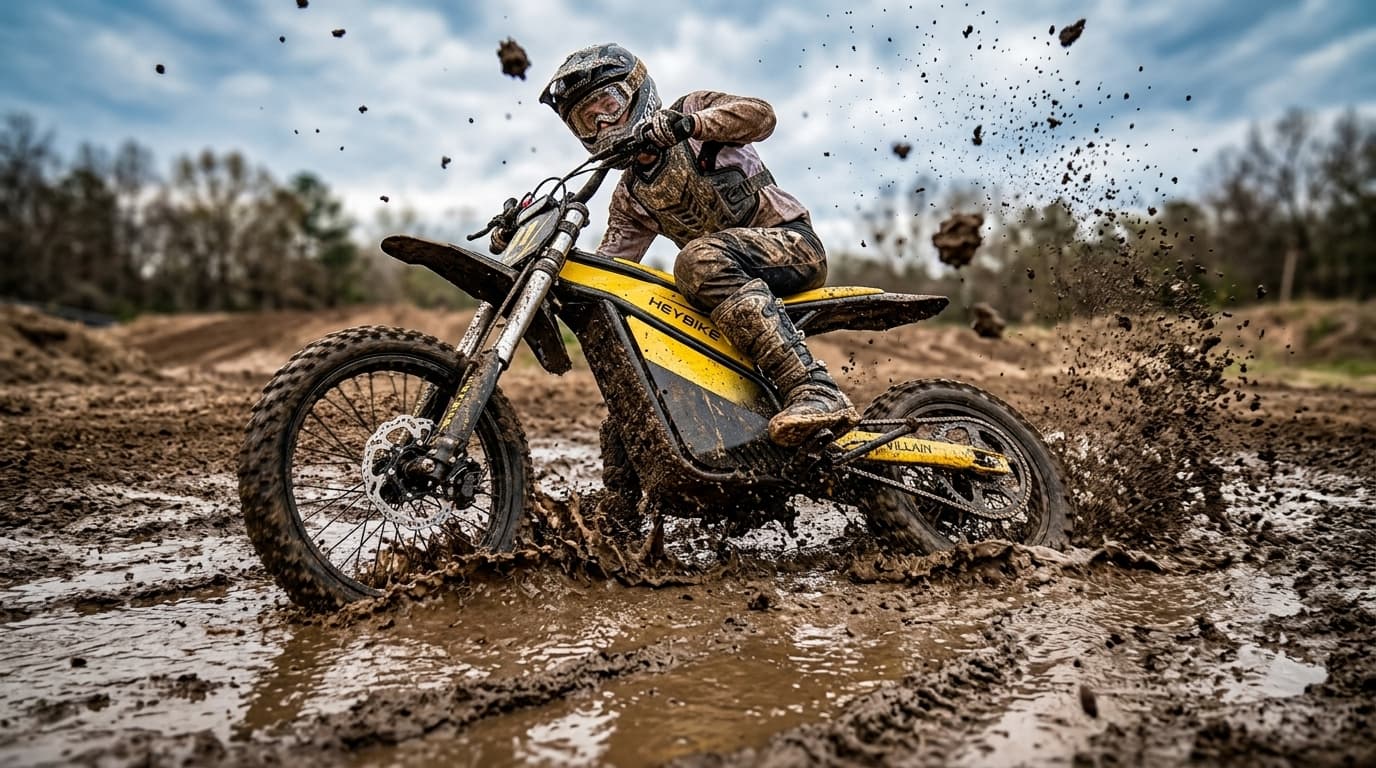
Top Speed Test: 45 mph Claimed vs. Reality
Heybike claims a 45 mph top speed for the Villain. Independent speed testing — using GPS-based measurement on flat ground with a standard-weight rider in the highest power mode — has verified approximately 44.3 mph.
That's a ~1.5% variance, which is remarkably honest. For context, here's how this compares to other claims in the electric dirt bike space:
- Heybike Villain: 45 mph claimed → ~44.3 mph tested (~1.5% variance)
- Many budget e-bikes: 30+ mph claimed → 25-28 mph tested (10-15% variance)
- Premium e-motos: Claims tend to be more accurate (within 3-5%)
The Villain's honest speed claim is a trust signal. When a manufacturer's numbers match reality, it builds confidence that their other claims are also reliable.
What Affects Top Speed
The 44.3 mph figure is achievable under specific conditions:
- Rider weight: Heavier riders will see slightly lower top speeds. The 265 lb payload limit means most adult riders can reach near-peak speed.
- Terrain: Flat, hard-packed ground yields the highest speed. Loose dirt, grass, or inclines reduce top speed noticeably.
- Battery charge: Top speed is most consistent above 30% charge. Below that, the controller may limit output to protect the battery.
- Power mode: The Villain's app-tunable controller lets you adjust power output. Lower power modes reduce top speed proportionally.
Range Test: The Honest Truth About 50 Miles
Heybike advertises up to 50 miles of range. Real-world testing consistently shows 15-25 miles on mixed terrain. This 50-60% gap between claim and reality is the single biggest point of confusion for potential buyers, so let's explain exactly why it exists.
How Manufacturers Test Range
Manufacturer range tests typically use ideal conditions that don't reflect real riding:
- Lowest power/assist mode
- Flat, paved surface
- Light rider (often 150 lb or less)
- Steady, moderate speed (15-20 mph)
- No stops, no acceleration bursts
- Optimal temperature (68-77°F)
These conditions are designed to maximize range, not simulate how most people ride an electric dirt bike. Nobody buys a 4,160W off-road machine to cruise at 15 mph on flat pavement.
Real-World Range Scenarios
Here's what to expect in different riding scenarios:
| Riding Style | Expected Range | Notes |
|---|---|---|
| Casual trail riding, moderate pace | 20-25 miles | Mixed terrain, occasional hills |
| Aggressive off-road, full throttle | 12-18 miles | Maximum power, steep hills, jumps |
| Flat road cruising, low power | 30-40 miles | Closest to manufacturer test conditions |
| Mixed commute (road + trail) | 18-25 miles | Typical real-world use |
Why the Gap Isn't a Defect
The range gap is a direct consequence of the motor's power output. A 4,160W motor drawing maximum current consumes energy roughly 2× faster than a 2,200W motor. You're buying the Villain because of that power — the range trade-off comes with it. This pattern is consistent across every high-torque electric dirt bike on the market, not just the Villain.
Think of it like a sports car vs. a sedan: the sports car has more power but burns more fuel. The "50 miles" claim is the equivalent of a car's highway MPG rating — technically achievable, but not representative of how most people drive.
How to Maximize Your Range
If range matters to you, here are practical tips to get the most from each charge:
- Use lower power modes: The app-tunable controller lets you reduce power output. In the lowest mode, you can extend range by 30-50%.
- Avoid constant full-throttle: Gradual acceleration uses far less energy than repeated full-throttle bursts.
- Maintain tire pressure: Under-inflated tires increase rolling resistance and reduce range.
- Ride at moderate speeds: Air resistance increases exponentially with speed. Cruising at 20 mph uses significantly less energy than 40 mph.
- Charge in optimal conditions: Extreme cold reduces battery capacity. Charge and store at room temperature when possible.
- Keep the battery above 20%: Deep discharges stress the battery and reduce long-term capacity.
Range vs. the Competition
How does the Villain's range compare to competitors?
- Windone RS5: Claims 45 miles; likely 18-28 miles real-world. Lower power draw may give a slight real-world range advantage.
- Yozma IN10 Pro: Claims 60 miles; likely 25-35 miles real-world. Larger battery compensates for higher power.
- Tasaca V58: Range data limited, but higher power output suggests similar or shorter range than the Villain.
The Villain's range is competitive for its power class. If you need more range, you'll need either a larger battery (higher price) or less power (different trade-off).
The Verdict on Speed and Range
The Heybike Villain's top speed claim is honest and verified. Its range claim requires the context that real-world conditions will yield 15-25 miles for most riders — but this is a category-wide pattern, not a Villain-specific problem. Understanding this trade-off upfront prevents disappointment and helps you make an informed buying decision.
If 15-25 miles of real-world range covers your typical ride, the Villain delivers excellent performance per dollar. If you need 30+ miles per charge, you'll want to consider bikes with larger batteries or lower power output.